At a time when most high-tech companies are hoarding patents and suing each other, creating a complex web of cold war-style mutually-assured destruction, Tesla is going against the crowd (once again) and open sourcing all of its patents, making its inventions available for anyone who wants to use them. No need to say that this is a big deal, and should be quite good for the electric car industry!
In a letter titled "All Our Patent Are Belong To You" published on Tesla's site, CEO Elon Musk writes that "Tesla Motors was created to accelerate the advent of sustainable transport. If we clear a path to the creation of compelling electric vehicles, but then lay intellectual property landmines behind us to inhibit others, we are acting in a manner contrary to that goal."
This means that the company will not sue anyone who wants to use their technology (as long as they act "in good faith", though it's not quite clear what a bad faith use of a patent would be).
Part of the reason behind this reversal, says Elon Musk, is that at first Tesla was worried that if they didn't protect their technology, big car manufacturers would copy it and then use their massive scale advantage in manufacturing, sales, marketing, etc, to crush them. But it turns out that this is not what happened:
The unfortunate reality is the opposite: electric car programs (or programs for any vehicle that doesn’t burn hydrocarbons) at the major manufacturers are small to non-existent, constituting an average of far less than 1% of their total vehicle sales.
At best, the large automakers are producing electric cars with limited range in limited volume. Some produce no zero emission cars at all.
Tesla sees its competition not as other electric cars, but as all the millions of gasoline cars that they're trying to replace. They feel they can't possibly do that by themselves, so might as well give a hand to their allies by sharing technology. Makes sense!
LAS VEGAS — Toyota made it clear today at the big Consumer Electronics Show that its fuel-cell technology is the future of automotive transportation.
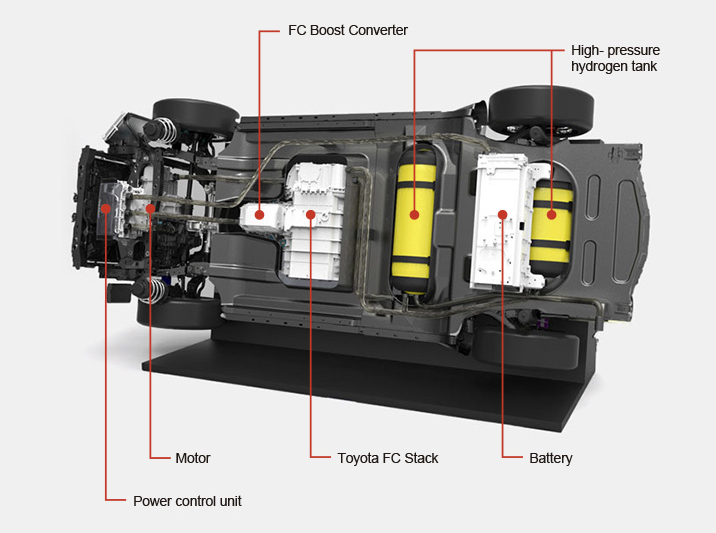
The car-maker on Monday held a press conference detailing the progress of the new Toyota Mirai, a hydrogen fuel cell vehicle that is powered by combining oxygen and hydrogen and will be commercially available later this year.
“We believe that hydrogen electric will be the primary fuel for the next 100 years,” said Bob Carter, a senior VP with Toyota’s US office.
Dr. Michio Kaku talks about Toyota’s fuel cell technology.
Perhaps the most newsworthy announcement came when Toyota said it would make all of its 5,680 patents related to fuel cell technology available, royalty-free, to other companies manufacturing and selling both fuel-cell vehicles and hydrogen refueling stations. The idea is to drive more innovation in this somewhat nascent sector of the automobile industry.
“It’s obvious that there can be a higher societal value in openly sharing our IP,” Carter said. “By eliminating the traditional corporate boundaries, we can speed the metabolism of everyone’s research and move into a future of mobility quicker, more effectively, and more economically. Indeed, I believe that today marks a turning point in automotive history.”
Toyota did something similar when it was developing the technology for its popular hybrid cars, but this marks the first time it has made its patents available free of charge. Tesla also gave away its patents last year.
“Hopefully by sharing these patents with others, the new fuel cell components and systems can be refined and improved to increase our performance, reduce our costs, and attract a broader market of buyers,” Carter said.
Bob Carter shows how the Mirai can provide electricity for a home.
The company today opened with remarks from Dr. Michio Kaku, a theoretical physicist and best-selling author. Kaku noted his initial skepticism for Toyota’s plans for hydrogen fuel cell cars, but explained why he’s convinced that this is a “game-changer.”
“The hydrogen car will change the landscape not just of our lives, but perhaps the world of politics, the world of energy — energy is at the very basis of all of modern society,” Kaku said. “We are present at the creation of a hydrogen society, a non-polluting society that will perhaps one day vanquish global warming and the problems associated with the burning of hydrocarbon fuels.”
The Mirai, which will be first sold in California later this year for $57,500 MSRP and then in the New England area, generates electricity by combining oxygen and hydrogen molecules — the only emission is water “so refined you could practically drink it,” Kaku noted. The car has a range of 300 miles and goes from 0-to-60 MPH in nine seconds. Unlike electric batteries, hydrogen tanks can be refilled in three-to-five minutes.
Carter also demonstrated how the Mirai can provide power to your house for up to a week in the event of emergencies, as we reported last year at Toyota’s CES press conference.
“Think of it as having an electric generator enclosed in your garage when there’s six feet of snow outside and it’s 30 below-zero, and have zero emissions to worry about on the inside,” Carter said. “In fact, we see this Toyota fuel cell system and this new Mirai as simply a better battery.”
However, one problem for Toyota is that it needs hydrogen fueling stations built in cities. Government agencies are helping, though, as the state of California gave $47 million in grants last year to help build 28 stations there. Toyota also has other partnerships to set up stations in the northeastern U.S, and Carter noted that by 2020, the company’s fueling infrastructure will reach “sustainable growth.”
“Very simply, we cannot have the car without the refueling stations,” Carter said. “We know that the day-in, day-out ownership experience will make or break this vision we have of the hydrogen society. That’s why Toyota will deliver on both the car, as well as the ownership experience.”
Toyota’s vision here is ambitious, but the company is confident that hydrogen-powered cars are the future.
“President Abraham Lincoln said the best way to predict the future is to create it,” Carter said. “That’s what we’re doing at Toyota.”
Dec 30, 2014 by Matt Burns (@mjburnsy) for TechCrunch
The Tesla Model S P85D packs dual electric motors and all-wheel drive. It’s basically a Porsche-killer that can transport seven people. And it utterly destroys the previous king of Teslas, the P85.
In the video above produced by Drag Times the P85D proves its worth by destroying a P85. It’s not even a race. The publication also recently took a P85D to a dyno to measure its torque,finding it packed 864 ft-lbs of torque. That’s double what’s found in a 2015 V8 Ford Mustang. But thanks to some sticky tires, all-wheel drive system and plenty of electronic controls, the P85D can clearly take advantage of that immense power as the drag race video above shows.
If anything, the sheer performance of the Tesla P85D (and even the older P85) should comfort gear heads fearing the EV revolution. Electric drivetrains can produce immense performance and excitement.
Find link to the original article on TechCrunch.com here.
A car called the Quant e-Sportlimousine that was presented at the 2014 Geneva Motor Show is the first electric car powered by salt water and is now certified for use on European public roads.
The e-Sportlimousine, built by the German company Quant, runs on an electrolyte flow cell power system made by NanoFlowcell that generates a staggering 920 horsepower, goes 0-62 mph in 2.8 seconds, and propels the car to a top speed of 217.5 mph!
What is an electrolyte flow cell you ask? According to Green Car Congress, “Flow cells or flow batteries combine aspects of an electrochemical battery cell with those of a fuel cell. The electrolytic fluids in flow cells—usually metallic salts in aqueous solution(salt water)—are pumped from tanks through the cell. This forms a kind of battery cell with a cross-flow of electrolyte liquid.”
“For the first time an automobile featuring flow-cell electric drive will appear on Germany’s roads,” said Nunzio La Vecchia, chief technical officer at NanoFlowcell, a company which designed the car. “We are extremely proud that as a small company we have developed such visionary technology and are now able to put it into practice. But this is only the beginning of our journey of discovery.”
A few months after making a debut at the 2014 Geneva Motor Show, the Quant e-Sportlimousine underwent an in-depth inspection and received official approval to be tested on public roads in Germany and Europe from certification provider TÜV Süd based in Munich, Germany.
The car is powered by the electrolyte flow cell power system, which is a part of the NanoFlowcell technology. The system works in a similar way to a hydrogen fuel cell, except for the fact that salt water is used for storing power. In particular, two liquids with metallic salts, which act as the electrolyte, are combined in such a way that the electrochemical reaction takes place. After that, electric motors use this reaction to generate electricity, which is then stored and distributed by super capacitors. The efficiency of this system reaches 80%, since the car has almost no moving parts in it, and the produced waste heat is insignificant in comparison with cars powered by lithium-ion batteries.
The company claims that the Quant e-Sportlimousine can reach the speed of 350 km/h (217.5 mph), accelerate from 0-100 in 2.8 seconds and has maximum power of 920 horsepower (680 kW). Moreover, the car is claimed to be able to travel up to 600 km (373 mi) with a full tank, which is five times greater than with a conventional battery system. At the same time, the car is safe to drive and environmentally friendly.
However, the market price of the Quant e-Sportlimousine is estimated to exceed $1.7. It is not yet clear if the company plans to use the NanoFlowcell technology on more affordable cars, but it can be said for sure that this technology has a great potential and could be used in a wide range of applications which go beyond the automobile industry.
Brazilian racecar driver Lucas di Grassi drives a Formula E race car in Berlin, Germany, last year. The first fully electric Formula racing championship will take place this fall.
PHOTOGRAPH BY HANNIBAL HANSCKE. PICTURE-ALLIANCE/DPA/AP
Electric cars have rounded a corner in their drive to enter the mainstream. Soon, you're going to be able to watch them race at high speeds.
The first public demonstration of the car that all ten teams will use, the Spark-Renault SRT_01E, is set for Monday at the Mandalay Bay Resort and Casino in Las Vegas. A former F1 driver, Brazilian Lucas de Grassi, the official test driver for the Formula E, will be behind the wheel of the vehicle, which was built by Spark Racing Technology together with a consortium of some of the leading motorsports manufacturers, including Dallara, McLaren, Renault, Williams, and Michelin.
Formula E's glitz quotient ramped up substantially in recent weeks, with announcements that teams will be fielded by film star and electric drive enthusiast Leonardo DiCaprio (paired with the French luxury electric carmaker Venturi Automobiles) and by billionaire Richard Branson's Virgin Group. Other competitors include conventional auto racing teams, like IndyCar teams Andretti Autosport and Jay Penske's Dragon Racing, as well as squads that focus entirely on green technology, like Drayson Racing of the United Kingdom.
Formula 1 may be the most glamorous racing series in the world, but those V-8 gasoline powered engines aren't exactly in touch with today's environmentally conscious society. To counter this, the FIA (Federation Internationale de l'Automobile) is getting set to launch Formula E.
Using electric cars that look suspiciously similar to their gas-guzzling F1 bretheren, Formula E will also be a global series, run on street circuits in different cities around the world. Ten teams will vie for the championship, and as in F1, each team will have two drivers. Of course one key problem with electric cars is their short range, so each driver will switch over to a fresh fully-charged car at the midway point in the race. That should make pit stops interesting.
The FIA says that the cars can accelerate from 0-60 mph in less than three seconds, so any thoughts that this will be like a bunch of racing golf carts should be quickly dispelled. One big difference will be noise levels, with Formula E cars at full speed making less noise than a city bus.
The inaugural Formula E series will kick off in Brazil on November 13 2014, with up to 12 races over the following eight months. Currently there are plans to hold two races in the USA, in Miami and Los Angeles. Hopefully they will remember to stop the normal commuter traffic on these street circuits, otherwise it could be a very slow race.
Check out the video to see a promo for Formula E. Perhaps they should reconsider the idea of having children playing next to the track with no barrier protection as you see at the 1.12 mark.
ENABLES FREE LONG DISTANCE TRAVEL BETWEEN SAN DIEGO AND VANCOUVER
WEDNESDAY, OCTOBER 30, 2013
PALO ALTO, Calif.-- Tesla Motors today announced the opening of the West Coast Supercharger Corridor, energizing a network of stations that enable Model S owners to travel for free between San Diego, California and Vancouver, British Columbia.
With stations along U.S. Highway 101 and Interstate 5, the West Coast’s key routes, cities and destinations are connected by Tesla Superchargers. Model S customers can drive between San Diego, Los Angeles, Santa Barbara, San Francisco, Sacramento, Portland, Seattle, and Vancouver for free with minimal stops. More than 99 percent of Californians and 87 percent of Oregon and Washington owners are now within 200 miles of a Supercharger.
Tesla Superchargers are substantially more powerful than any other charging technology in the world, capable of charging Model S 20x faster than most public charging stations. Superchargers deliver up to 120 kW DC (Direct Current) power directly to the Model S battery, providing half a charge in as little as 20 minutes. Superchargers are strategically placed along major highways connecting city centers. Stations are located where customers want to stop, near amenities like roadside diners, cafes and shopping centers, so owners can stop for a quick meal while their Model S charges for free. This morning in San Diego, two Model S will embark on a 1,750 mile #DriveFree road trip to Vancouver powered only by Tesla Superchargers. The journey will take them through Santa Barbara, San Francisco, Sacramento, Mt. Shasta, Portland, Seattle, and Vancouver, with stops at popular destinations such as the Santa Monica pier, Monterey Bay and the world famous Pike Place Fish Market. Throughout the trip, Tesla will be hosting owner and media events and providing real time updates from the road on Twitter, Facebook and Instagram
ABOUT TESLA
Tesla Motors' (NASDAQ: TSLA) goal is to accelerate the world's transition to electric mobility with a full range of increasingly affordable electric cars. California-based Tesla designs and manufactures EVs, as well as EV powertrain components for industry partners.


 © Tesla
 Youtube/Screen capture


 However, one problem for Toyota is that it needs hydrogen fueling stations built in cities. Government agencies are helping, though, as the state of California


